Designing clarity and adoption for complex, high-risk platforms
Context
Cloud computing and cybersecurity are conceptually dense, fragmented across vendors, and unforgiving when misunderstood. This project focused on enabling non-specialist users to safely understand and apply cloud and security concepts in a regulated, large-scale environment.
The Problem
Traditional cloud courses optimise for coverage and certification, not usability. Learners struggle to form mental models, connect concepts across platforms, and make risk-aware decisions.
My Role
I designed the enablement structure, learning flow, and interaction strategy—translating expert cloud and security knowledge into a usable system that supports understanding, confidence, and safe application.
Constraints
Regulatory accuracy · vendor terminology · fixed outcomes · LMS limits · large cohorts
- The Enablement Approach
- Mental models before tools
- Identity, networking, and logging as foundational systems
- Scenario-based decision points instead of linear content
- Repeated reinforcement across platforms to prevent tool-first thinking
Outcome
A scalable enablement system that reduced cognitive overload, improved conceptual clarity, and aligned learning with real-world cloud and security practice.
- Next Iteration:
- Role-based pathways
- just-in-time references
- incident-first learning
- cross-vendor system maps
Key takeaway: This was not a course — it was an enablement system designed to help people think safely in complex cloud environments.
Layered Enablement System

Understanding first. Tools second. Decisions always.
Problem Space
Cloud and cybersecurity are rarely difficult because of the tools.
They’re difficult because people are asked to make decisions before they understand the systems those decisions affect.
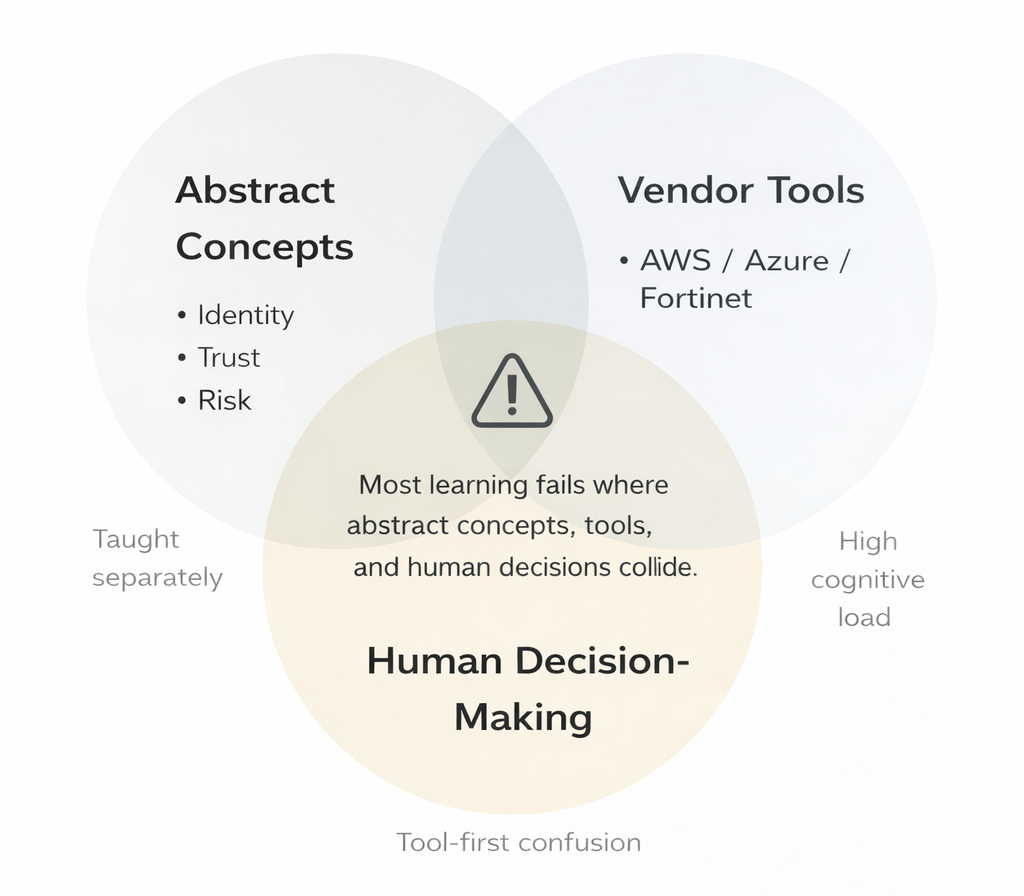
Most learning approaches treat cloud platforms, security concepts, and human behaviour as separate problems. Abstract ideas are taught in isolation, tools are introduced too early, and decision-making is left to experience or trial-and-error. The result is cognitive overload, tool-first confusion, and fragile understanding.
The real failure point isn’t any single concept or platform — it’s where abstract concepts, vendor tools, and human decision-making collide.
The diagram below maps this problem space and explains why traditional cloud and security learning breaks down.
Why Cloud & Security Learning Fails
Even when the content is accurate and well-intentioned, traditional cloud and cybersecurity learning often fails at the moment users try to apply it. Linear courses prioritise coverage and progression over usability, forcing learners to navigate complex systems without a coherent mental model.
This project reframed the problem from delivering content to enabling understanding. Instead of asking users to memorise tools or workflows, the focus shifted to building transferable mental models, supporting decision-making, and reinforcing safe practice across platforms.
The diagram below shows the shift from a traditional, course-centric approach to a usable enablement system.

What This Looks Like in Practice
This case study explains the why.
The sample enablement playbook shows the how.
The PDF is a practical, decision-focused guide designed to help non-specialists reason about cloud and security systems without relying on tool-specific training.
Leave a Reply